- Money254 Money Weekly
- Posts
- Housing Levy Trapped Billions as Kiambu Road Dual Carriageway Takes Shape
Housing Levy Trapped Billions as Kiambu Road Dual Carriageway Takes Shape
Employers evade 1.5% Housing Levy without consequences. Housing Levy funds get trapped in Treasury Bills. The government awards a Ksh38 billion tender to a Chinese firm to dual Kiambu Road. The Ministry of Interior earmarks 37 estates prone to floods as rains intensify. All this and more in today’s Money Weekly newsletter. But first, a closer look at the Housing Levy news.

Washington Mito
March 19, 2026
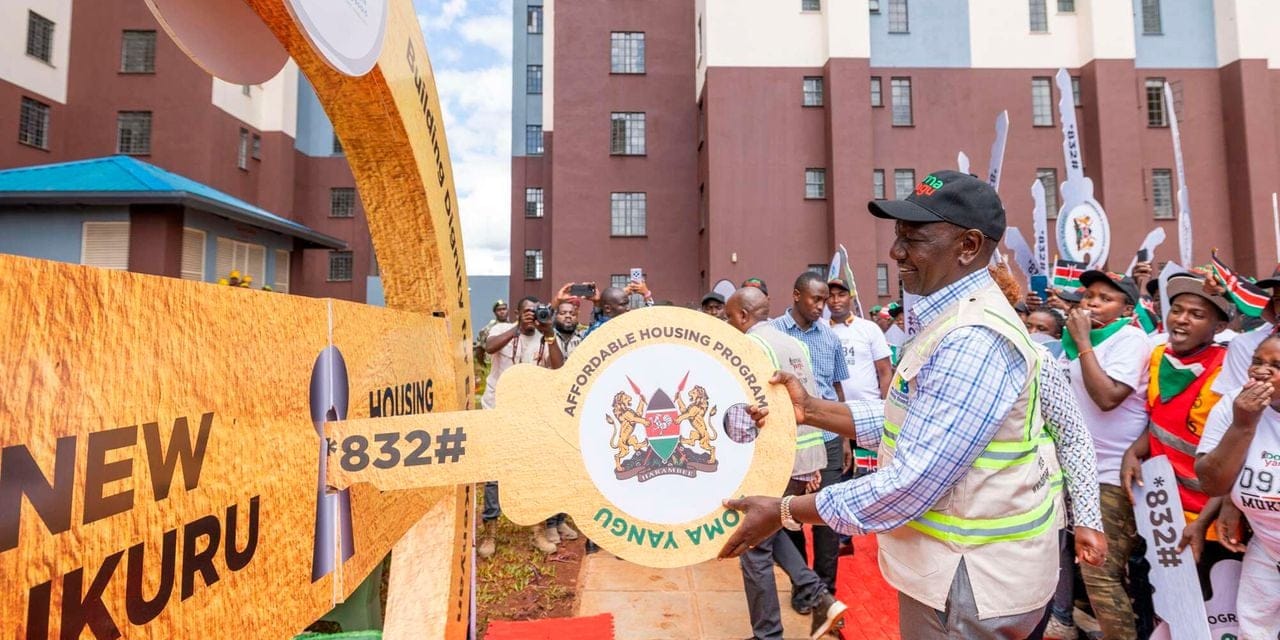
Hello and welcome to the Money Weekly Newsletter, where we cover how some employers are evading the 1.5% Housing Levy without consequences.
But first, a word from our sponsoring partner, M-KOPA.
Sponsored Content
Have you ever owned a phone that not only keeps you connected but also unlocks access to loans and gives you free insurance?
With M-KOPA’s range of phones, you get exactly that and more. Free health insurance from Turaco? Check. Device protection against theft or damage? Check. Access to loans just three months after purchase? Check. Plus, the S34, equipped with a strong 13MP camera, lets you capture high-quality photos to elevate your business. Get Yours Today!

Employers Evade Housing Levy
Auditor General Nancy Gathungu has revealed that some employers are evading the mandatory 1.5% Housing Levy due to a legal loophole in the Affordable Housing Act.
In a report, the auditor noted that KRA, which collects the levy on behalf of the Affordable Housing Board, does not have the power to enforce compliance with payments under the Act.
On the other hand, the Affordable Housing Board, which has the power to enforce compliance, does not have access to taxpayers' data. Therefore, it cannot determine who is paying or defaulting.
As per the law, employers are required to deduct 1.5% from the gross salary of an employee and remit it to KRA. Employers are also required to match the contributions.
However, with the existing loophole in the law, 6,390 employers are reported to have exploited the gap and have failed to make the deductions meant to fund the construction of houses.
Any person who fails to comply with the law shall be liable to pay a penalty equivalent to 3% of the unpaid funds for every month if the same remains unpaid.
With the new revelations from the auditor, the government may move to amend the Act to ensure that compliance is enforced either by KRA or by empowering the Board.
Meanwhile, still on affordable housing, PS Charles Hinga has revealed that the Ksh25 billion collected through the Housing Levy has been tied up in investments in Treasury Bills, posing a risk to ongoing projects.
According to Hinga, the Treasury will have to approve the release of the funds invested in the 91-day T-Bills or 1,700 projects risk stalling. As a result, Hinga has asked Parliament to include the Ksh25 billion in the supplementary budget.
As of June 2025, the Auditor General revealed that approximately Ksh45 billion had been invested in government securities, including T-Bills.
In a separate report, the State Department for Housing noted that investing in T-Bills had earned the government Ksh4.2 billion in interest.
Notably, there has been unprecedented oversubscription of T-Bills, with recent auctions reaching record-breaking levels as investors flooded the market with over Ksh100 billion in weekly bids.
This surge in demand has been largely driven by a liquidity surplus in the banking sector.
Here is a quick recap of the top money news for the week:
Kiambu Road Dual Carriageway Takes Shape
The expansion of Kiambu Road into a dual carriageway is set to kick-start after the government awarded the Ksh38 billion tender to Stecol Corporation, a Chinese firm. The 23-kilometre road will run from Pangani through Muthaiga, Ridgeways, Windsor, and Runda to Ndumberi.
The project will be financed through a loan from the Export-Import Bank of China, and construction will run for 36 months. Kiambu Road is one of the major roads that has experienced heavy traffic snarl-ups during rush hours.
Catch Up on More News




WEEKLY MONEY TIPS


.jpg)
MONEY254 #MONEYTOK
Investing Housing Levy Billions in T-Bills Now Risks Affordable Housing Projects
The decision to invest money raised through the Housing Levy in T-Bills has come back to haunt the government, with over 1,700 construction projects at the risk of stalling. Over Ksh25 billion needed to complete affordable housing projects across the country has become unavailable because it is tied up in T-Bills.
In 2025, the government made the decision to invest some of the cash raised through the Housing Levy in bonds and Treasury Bills. The idea then was that it would generate interest before it was deployed.
On Wednesday, Housing PS Charles Hinga told Parliament that contractors risk going unpaid and construction could grind to a halt if the funds aren’t released in time.
Hinga noted that the cash was sitting with the Treasury, and getting it back to the sites requires a long approval process. The PS complained that Treasury officials were slowing down the approvals, which posed a risk to the project.
@money254hq 𝐈𝐧𝐯𝐞𝐬𝐭𝐢𝐧𝐠 𝐇𝐨𝐮𝐬𝐢𝐧𝐠 𝐋𝐞𝐯𝐲 𝐁𝐢𝐥𝐥𝐢𝐨𝐧𝐬 𝐢𝐧 𝐓-𝐁𝐢𝐥𝐥𝐬 𝐍𝐨𝐰 𝐑𝐢𝐬𝐤𝐬 𝐀𝐟𝐟𝐨𝐫𝐝𝐚𝐛𝐥𝐞 𝐇𝐨𝐮𝐬𝐢𝐧𝐠 𝐏𝐫𝐨𝐣𝐞𝐜𝐭𝐬 The decision to invest money raised through the Housing L... See more
That’s a wrap for this week’s Money Weekly!
Remember that we can help you compare over 300 loans, savings accounts, current accounts, and more on our website if you’re thinking about your next product.
❤️ Share with a friend
Thanks for reading. If you liked this week’s Wallet Wellness email, we’d love for you to share it with a friend.
If this email was forwarded to you, you can subscribe here.